Every tour operator in Dubrovnik will take you to the Blue Cave. It is the headline attraction for a reason — that electric-blue light reflecting off the cave walls is genuinely unforgettable. But here is the thing most visitors never hear: the coastline between Dubrovnik and the Elaphiti Islands is scattered with spots that are just as striking, and almost nobody visits them.
Generic operators run the same route, boat after boat, day after day. They motor past hidden coves, unmarked swimming holes, and sea arches that local skippers have known about for generations. We grew up on these waters, and we built our Blue Cave tours around the stretch of coast that makes this part of the Adriatic truly special — one of the spots below is even a fixed stop on every scheduled tour.
Here are seven of our favourites.
1. The Turquoise Pool Below Koločep’s Eastern Cliffs
On the seaward side of Koločep, away from the ferry dock, a collapsed overhang has created a natural pool roughly fifteen metres across. The water is startlingly turquoise — even by Adriatic standards — because the white limestone bed reflects sunlight back up through less than three metres of depth.
Most boats approach Koločep from the north. Come around the eastern cliffs at low throttle instead, and the pool appears only once you clear the last headland. There is no path to it from the island. The only way in is by sea.
On a private charter we can cut the engine here and let guests swim or snorkel for twenty minutes. The cliff walls block the wind, so the surface stays glassy. Underwater, you will find sea urchins, wrasse darting between rocks, and the occasional octopus tucked into a crevice.
2. Sveti Andrija’s Sea Arch
Sveti Andrija (St. Andrew) is a tiny island between Šipan and the open sea — home to a decommissioned lighthouse and not much else. On the island’s southwest face, wave erosion has carved a perfect arch wide enough for our boat to idle through at calm sea.
Passing through the arch is one of those moments where everyone reaches for a camera. The rock frames the horizon on the far side, and light pours through at angles that make the water glow. On private trips we time our visits for mid-morning when the sun is high enough to light the passage but low enough to create contrast against the stone.
You will not find this arch on any mainstream tour itinerary. It requires a skipper who knows the approach depth and can read the swell — a few rocks sit just below the waterline.
3. The Snorkelling Wall Off Lopud’s South Shore
Lopud is the middle island of the Elaphiti chain, and most visitors know it for Šunj Beach on the far side. What they do not know is that the south-facing shore drops off steeply about forty metres from land, forming an underwater wall that runs for nearly two hundred metres.
This wall is the best snorkelling on the entire Elaphiti Islands coastline in our opinion. The rock is covered in orange and purple sponges, and the visibility regularly exceeds fifteen metres. We have seen moray eels here, schools of salema, and — on good days — a group of bottlenose dolphins that patrols the channel between Lopud and Šipan.
On a private charter we anchor just off the wall — snorkelling gear is on board every boat we run. Even guests who are not strong swimmers can hold the boat line and peer over the drop-off. It is a completely different experience from snorkelling in shallow sandy bays.
4. The Hidden Pebble Beach at Sutvid Cove
Between the main Koločep settlements of Donje Čelo and Gornje Čelo, the coastline curves inward to form a cove that does not appear on most maps. Locals call it Sutvid, after the small chapel ruin above the treeline. The beach is perhaps thirty metres of smooth white pebble backed by dense pine forest.
There is a footpath from Gornje Čelo, but it is unmarked and overgrown enough that hardly anyone walks it. By boat, it is a two-minute detour from the standard Koločep approach. We stop here on private charters when the group wants a quiet swim in shallow water — perfect for families or anyone who prefers to ease into the Adriatic rather than jump off a cliff.
The pine trees provide natural shade right to the waterline, which matters more than you might think at midday in July and August.
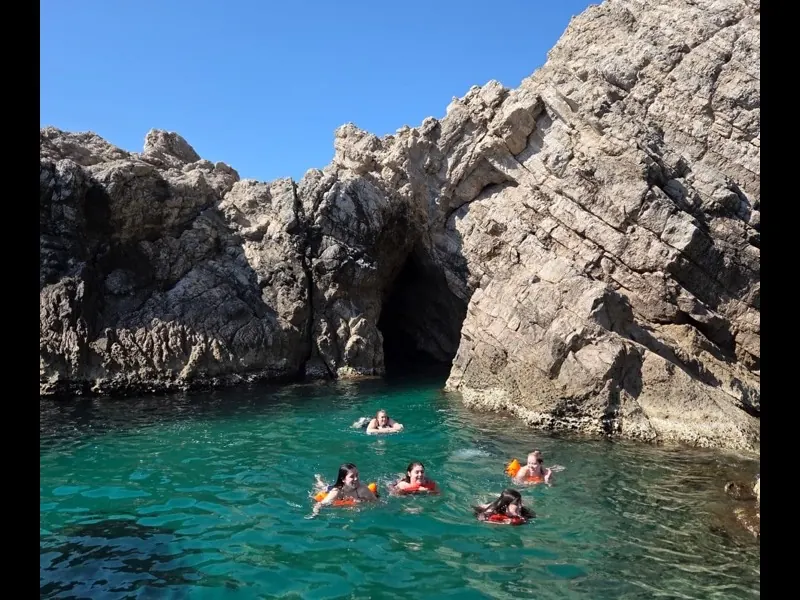
5. Spilja Cave in Zaton Bay
Heading back along the mainland coast, the shoreline curves into Zaton — a long, sheltered bay that most tour boats pass without a second glance. Tucked into its rocks is a hidden sea cave locals simply call Spilja — ‘the cave’. The entrance is easy to miss even when you know where to look, all but invisible until the boat is nearly on top of it.
Unlike the Blue Cave, Spilja does not rely on refracted light for its drama. It is the stillness. We idle in, cut the engine, and let the silence settle. After a day of swimming and open water, fifteen minutes in this quiet, shadowed chamber is the perfect wind-down.
Here is the best part: this is the one spot on this list you do not need a private charter to see. Spilja is the final stop on every scheduled tour we run — see where it fits on our island-hopping routes — a last piece of local knowledge on the way back to the marina.
6. Misješta Bay’s Underwater Boulders
On the western tip of Šipan, the largest of the Elaphiti Islands, there is a bay called Misješta where several house-sized boulders sit on the seabed in about five metres of water. They likely fell from the cliffs above centuries ago, and marine life has turned them into miniature reefs.
Snorkelling around these boulders is like visiting an underwater garden. Each face hosts a different community — sea fans on the shaded north side, algae meadows on top where sunlight hits, and small groupers lurking in the gaps between rocks. The water is calm because the bay faces away from the prevailing northwest wind.
Misješta is private-charter territory — whether we include it depends on conditions and the group’s interests. But when we do, it consistently gets the strongest reactions. Guests who have snorkelled across the Mediterranean tell us they have never seen anything quite like these boulders.
7. The Cliff Jumping Ledge at Koločep’s Western Point
For guests who want adrenaline, there is a flat rock ledge on Koločep’s western point that sits roughly four metres above deep, clear water. Local teenagers have been jumping off it for decades. The depth below is well over six metres, and the approach is clear of underwater obstacles — we have checked it ourselves more times than we can count.
On private trips we bring the boat alongside, and those who want to jump climb up via a natural step in the rock. Four metres does not sound like much until you are standing on the edge looking down. It is high enough to feel thrilling but safe enough that we are comfortable offering it to any confident swimmer.
Not every guest takes the jump, and that is fine. The ledge also offers one of the best panoramic views of the Elaphiti channel, so it works as a photo stop regardless.
Why These Spots Matter
The difference between a good Blue Cave tour and a great one is everything that happens outside the cave. You get about 15 to 20 minutes in the water inside the Blue Cave itself. The rest of your roughly four-hour tour is spent on the water and at the other stops.
Generic operators fill that time with the same fixed rotation: the Blue Cave, a quick pass at one of the green caves, a beach on Šipan, a beach on Lopud, lunch in a harbour. Pleasant, but identical to what every other boat is doing — which means you arrive at each stop alongside six other groups.
Our skippers grew up on these waters. They know which coves are sheltered when the maestral picks up, where the snorkelling is best at which hour, and the hidden pebble beaches that do not have names on Google Maps.
Our scheduled route bakes this local knowledge in — the Three Green Caves on Koločep’s west shore, forty-five minutes of free time in the island’s car-free village, and Spilja cave in Zaton as the final stop. Book a private charter and the rest of this list opens up too. Either way, when you book with us, you are on the water with someone who knows this coastline the way a local knows their own neighbourhood.
Planning Your Visit
These spots are accessible from May through October, with the best conditions between June and September. Water temperatures peak at around 25°C in August, and visibility is strongest in June before the summer plankton bloom.
We recommend morning departures for the calmest water and best light inside caves and arches. Afternoon tours work well too, especially later in the season when water temperatures peak.
Browse our full range of Dubrovnik boat tours to find the right fit, or explore our detailed guide to the Elaphiti Islands if you want to learn more about the archipelago before you arrive.
Bring reef-safe sunscreen, a towel (the one thing we do not provide), and a sense of curiosity. We will handle the rest — snorkelling gear, life jackets, drinks, and admissions are all included.