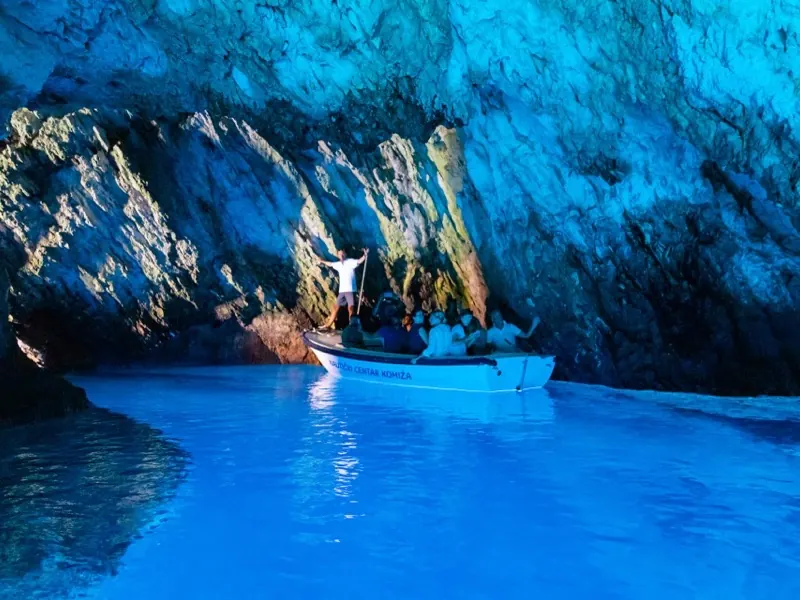
Updated April 2026 — The Blue Cave near Dubrovnik is one of the most extraordinary natural wonders on the Adriatic coast. Whether you are planning your first trip or returning to see the cave in a different light — literally — this guide covers everything: the science behind the glow, how to get there, what every tour costs, and the small details that separate a good visit from an unforgettable one.
A Brief History of the Blue Cave
The Blue Cave on the island of Biševo, near Vis, has been known to local fishermen for centuries. But the sea grotto most visitors from Dubrovnik experience sits along the coastline closer to the Elaphiti Islands and the Dubrovnik Riviera. Early mentions of these coastal caves appear in Ragusan maritime records from the 16th century, where sailors described “chambers of blue fire” glowing beneath the cliffs.
Modern tourism to the cave began in the mid-20th century, when local boat operators started offering excursions from Dubrovnik’s Old Port. By the 1990s, the grotto had become a fixture on the Dalmatian itinerary. Today it is one of the most visited natural attractions on the Croatian coast, drawing tens of thousands of visitors each season.
Geology — How the Cave Was Formed
The cave owes its existence to millions of years of geological activity along the Adriatic coastline. The Dinaric Alps — the mountain range that parallels Croatia’s coast — are composed largely of Mesozoic limestone, a sedimentary rock that dissolves slowly in seawater.
Over millennia, waves, tidal currents, and slightly acidic rainwater carved passages into the limestone cliffs. Tectonic shifts opened and widened fractures, creating the chamber visitors enter today. The cave floor sits several metres below sea level, while the ceiling arches roughly five to six metres above the waterline. A submerged opening on the seaward side — too narrow for boats but wide enough for light — is the key to the entire spectacle.
How the Blue Light Works
The blue glow is not bioluminescence, artificial lighting, or a trick of the eye. It is pure optics.
Sunlight enters the cave through the underwater opening. As it passes through the seawater, the water column absorbs the longer wavelengths of visible light — reds, oranges, and yellows — and transmits the shorter blue wavelengths. The light then reflects off the white limestone floor and walls, flooding the interior with an intense, almost electric blue.
The effect is strongest when three conditions align:
- High sun angle — the sun must be high enough to send light through the submerged entrance at the correct angle.
- Calm seas — rough water scatters the light and disturbs sediment, dulling the colour.
- Clear water — low plankton density and minimal sediment keep the water column transparent.
This is why the time of day and the time of year matter so much. More on that below.
How to Get There from Dubrovnik
The cave is not accessible on foot. Every visit begins with a boat ride, and our tours check in at the GariTransfer office — look for the yellow flag — inside Marina Frapa, Lapadska obala 21a, on the Gruž side of the city.
The route: Marina Frapa → north-west under the Franjo Tuđman Bridge → past Grebeni Lighthouse off Lapad and Lighthouse Bezdanj on Koločep → arrival at the cave entrance. The ride takes roughly 20–30 minutes depending on sea conditions.
The entrance is too low for the boat, so the skipper holds position at the opening and you swim in with mask and snorkel. Inside the cave, you spend approximately 15 to 20 minutes in the water. The tour then continues to the Three Green Caves, Koločep village, and Spilja cave in Zaton bay before returning to the marina.
For a full breakdown of the journey, see our how to visit the Blue Cave from Dubrovnik guide.
What to Expect — Hour by Hour
Here is what a typical tour day looks like:
Before departure (15 min before): Arrive at the GariTransfer office inside Marina Frapa — the yellow flag marks it — check in, and your skipper welcomes you and walks you to the boat. Life jackets and snorkelling gear are provided.
Departure to cave (20–30 min): The boat heads north-west under the Franjo Tuđman Bridge. Your skipper points out landmarks — Grebeni Lighthouse off Lapad, then Lighthouse Bezdanj on the approach to Koločep.
Cave stop (45 min, with 15–20 min in the water inside): The skipper holds the boat at the low cave mouth and you swim in. Inside, near-silence — you float as the blue light fills the chamber, with time for photos, snorkelling, and simply absorbing the atmosphere.
Three more stops (roughly 2 hours): Next come the Three Green Caves on Koločep’s west shore — a trio of connected caves glowing emerald, and the longest swim stop at 50 minutes. Then 45 minutes of free time in Koločep’s car-free village, and a final 15-minute stop at Spilja, a hidden cave in Zaton bay. Wine, beer, soft drinks, and bottled water are included aboard.
Return to the marina (20–30 min): The boat heads back to Marina Frapa. The 10:00 morning tour is back around 14:00; the 14:15 afternoon tour returns by 18:15.
Tour Options and Pricing for 2026
Dubrovnik offers several ways to visit the Blue Cave. Here is how they compare. For the latest prices and availability, visit our pricing page.
Group Boat Tour
- Duration: 3–5 hours
- Price: €49–€80 per person across Dubrovnik operators. Blue Cave Tours Dubrovnik sits at the low end at €49 per person (reduced from €60 on 2026-08-02) — no other Dubrovnik-departure operator currently offers a 4-hour group tour at this price.
- Group size: 10–20 passengers
- Includes: cave visit, 1–2 swimming stops, guide, life jackets
- Best for: Solo travellers, couples, and budget-conscious visitors
Private Speedboat Tour
- Duration: 4–6 hours
- Price: €400–€700 per boat (up to 8 passengers)
- Includes: cave visit, flexible itinerary, snorkelling gear, drinks
- Best for: Families, small groups, anyone wanting a personalised experience
Full-Day Island-Hopping Tour
- Duration: 7–9 hours
- Price: €90–€130 per person
- Group size: 8–15 passengers
- Includes: cave entry, Elaphiti Islands, lunch, multiple swimming stops
- Best for: Visitors who want to combine the cave with a full day on the water
All tours depart from Dubrovnik. Book your Blue Cave tour here to secure your preferred date.
Best Time of Day to Visit
The blue light effect depends entirely on the sun’s position. The optimal window is between 10:00 and 13:00, when the sun is high enough to send light through the submerged entrance at the ideal angle.
- Before 09:00: Light is too low; the cave interior appears dim and grey-green.
- 10:00–13:00: Peak blue intensity. This is when most tours are scheduled.
- 14:00–16:00: The light shifts, becoming softer. Still beautiful, but less vivid.
- After 16:00: The sun drops too low; the effect fades significantly.
Morning tours that arrive at the cave between 10:30 and 11:30 consistently deliver the most spectacular light.
Best Time of Year to Visit
The cave is accessible from roughly April through October, but conditions vary:
| Month | Blue Light Quality | Sea Conditions | Crowds |
|---|---|---|---|
| April–May | Good to excellent | Generally calm | Low |
| June | Excellent | Calm | Moderate |
| July–August | Excellent | Calm | High |
| September | Excellent | Calm | Moderate |
| October | Good | Occasionally rough | Low |
June and September offer the best balance: strong light, warm water for swimming, and fewer crowds than July–August. For a deeper analysis, see our best time to visit the Blue Cave page.
What to Wear
Dress for a day on the water, not a day in the city.
- Swimsuit under your clothes — most tours include swimming stops.
- Light layers — mornings can be cool on the water, even in summer. A windbreaker or light fleece is useful.
- Non-slip shoes or sport sandals — boat decks are wet. Avoid flip-flops; they offer no grip. Avoid heels entirely.
- Sun hat with a chin strap — wind on the open water will take an unsecured hat.
- Sunglasses with a strap — polarised lenses reduce glare and improve your view of the underwater light effects.
What to Bring
A well-packed small bag makes a real difference:
- Reef-safe sunscreen (SPF 50) — reapply after swimming.
- Water bottle (1–1.5 litres) — dehydration on the water is sneaky; the breeze masks how much you sweat.
- Towel and dry bag — a dry bag protects electronics and clothing from spray.
- Snacks — some tours include food, but small energy snacks are always useful.
- Cash (small notes) — all cave admissions are included in the tour price, so keep small notes only for taverna purchases during the free time on Koločep.
Dealing with Motion Sickness
The boat ride crosses open water. If you are prone to seasickness, take it seriously — it can ruin an otherwise magnificent day.
Before the trip:
- Take motion sickness medication (dramamine or meclizine) 30–60 minutes before boarding. Don’t wait until you feel unwell.
- Eat a light, bland meal beforehand. An empty stomach is worse than a settled one.
- Avoid heavy alcohol the night before.
On the boat:
- Sit in the middle of the boat, where rocking is least pronounced.
- Face forward and watch the horizon — it gives your inner ear a stable reference point.
- Stay in fresh air. Avoid going below deck or staring at your phone.
- Ginger tablets or acupressure wristbands help some people, though evidence is mixed.
Sea conditions are almost always calmest in the morning. Another reason to book an early tour.
Photography Tips
The cave rewards photographers who prepare.
Camera Settings
- ISO 800–1600 — the cave interior is dim despite the glow. You need a high ISO to avoid blur.
- Aperture f/2.8–f/4 — open wide to capture as much light as possible.
- Shutter speed 1/60–1/125 — slow enough for light, fast enough to counteract boat movement.
- White balance: daylight or shade — auto white balance often overcorrects the blue, making it look less vivid than it is. Manual daylight or shade preserves the true colour.
- Shoot RAW — the dynamic range inside the cave is tricky. RAW gives you far more flexibility in post-processing.
Best Angles
- Low and wide — hold your camera just above the waterline and shoot across the surface. This captures the blue reflection on the water and the illuminated walls together.
- Upward toward the ceiling — the light diffuses beautifully across the limestone above.
- Include a person for scale — the cave is larger than it looks in photos. A silhouette against the blue glow adds drama and a sense of proportion.
Waterproof Protection
Spray inside the cave and during the boat ride is unavoidable. Protect your gear:
- Waterproof phone pouch — inexpensive and effective. Test it in the sink before the trip.
- Waterproof camera (GoPro or similar) — ideal for both cave shots and underwater swimming photos.
- DSLR/mirrorless rain cover — a simple rain sleeve keeps spray off without restricting access to controls.
Do not bring a drone. Flying inside the cave is prohibited, and regulations restrict drone use along much of the coastline.
Biševo Blue Cave vs. Dubrovnik Blue Cave
If you have researched Blue Caves in Croatia, you have probably encountered two names: the Blue Cave on Biševo (near the island of Vis) and the Blue Cave accessible from Dubrovnik.
They are different caves in different locations.
- Biševo Blue Cave is on a small island near Vis, roughly 5–6 hours from Dubrovnik by ferry and boat. It is the more famous of the two internationally. Visiting from Dubrovnik as a day trip is impractical.
- The Dubrovnik Blue Cave is along the coastline accessible from Dubrovnik and reachable in under an hour by speedboat. The blue light phenomenon is the same — same optics, same limestone geology — but the cave dimensions and setting differ.
If you are staying in Dubrovnik, the local Blue Cave is your option. It delivers the same otherworldly blue light without the full-day travel to Vis. Wondering whether the experience justifies the cost? Read our honest breakdown: Is the Blue Cave tour from Dubrovnik worth it?
Conservation and Responsible Visiting
The cave is a fragile environment. The limestone formations took millions of years to develop, and the water clarity that creates the blue light depends on a healthy marine ecosystem.
What you can do:
- Do not touch the cave walls. Oils from skin accelerate erosion of the soft limestone.
- Do not leave anything behind. No rubbish, no sunscreen residue in the water if avoidable (use reef-safe products).
- Follow your guide’s instructions. Boat operators know the cave’s limits — how many vessels can enter safely, how long to stay, and which areas to avoid.
- Choose responsible operators. Look for tours that limit group sizes, follow marine park regulations, and brief passengers on conservation practices. Our tours are designed with these principles at the core.
Croatian authorities periodically restrict access to sea caves when conditions risk damage — high water, erosion events, or marine life nesting. If your tour is rerouted, it is for the cave’s long-term preservation.
Final Thoughts
The cave is one of those rare natural sites that genuinely lives up to its reputation. The blue glow is more vivid in person than any photo suggests, and the silence inside — nothing but water lapping against rock — is a moment most visitors remember long after the tan fades.
Plan your visit with the right tour, at the right time, and with the right expectations, and you will see why this cave draws people back to Dubrovnik year after year.
Ready to go? Browse all Blue Cave tours from Dubrovnik and find the one that fits your schedule and budget.